Showing posts with label memoir. Show all posts

Monday, September 20, 2010

When God gives you AIDS ... make lemonAIDS

The Bedwetter
Sarah Silverman

Here's another August read that I've simply delayed discussing sooner. I'm not sure what led me to read The Bedwetter -- I'm not the hugest fan of Silverman, but that's really due to the fact I'm in bed absurdly early and she mostly appears on late-night tv.

I guess what really made me interested in reading more about her was her video Sell the Vatican, Feed the World. Funny, yes, but not entirely a bad idea, either.

Anyway, long story short - picked this little gem up from the library. The Bedwetter was at times laugh-out-loud hysterical (the story about her brother alone makes it worthwhile) and at others insightful and thoughtful. Reading about her experiences as a bedwetter and later as an SNL writer made for a quick, fun read.

In a nutshell: If you are ultra-PC, you might want to skip this one. Otherwise, it's nearly impossible not to laugh at The Bedwetter, even if you're not familiar with her work.

Bibliolatry Scale: 4 out of 6 stars

FTCBS: Libraryed this one. That's like the third library book this year! Awww yeah, kicking it old school.


Monday, February 23, 2009

I want to run away for a year, too!

Eat, Pray, Love: One Woman's Search for Everything Across Italy, India and Indonesia
Elizabeth Gilbert

So I finally rode the Eat, Pray, Love train, even though this book isn't exactly new and exciting to most people. I feared the hype machine would trick me into reading yet another turd, but I was pleasantly surprised. The latest stop on my reading resolution tour wasn't perfect, but it was a fast, engaging piece that -- for the most part -- lived up to its hype.

Eat, Pray, Love is a memoir that recounts one woman's quest for fulfillment. Elizabeth Gilbert's life falls apart when she realizes that her marriage is over. After a bitter divorce, Gilbert leaves the US to find herself. She spends a year abroad and travels to three different areas to learn three different lessons. She travels to Italy to embrace physical pleasures and lots of pasta. From there, she travels to India to embrace spiritual fulfillment in an ashram. Finally, she travels to Indonesia to achieve balance between the worlds of the physical and the spiritual.

I enjoyed Gilbert's style, and found her writing to be conversational and enjoyable. Part of me felt more than a little bitter at her ability to just "run away" for a year and live totally free of any "real life" issues. (And I'm not saying that her journey was problem-free -- of course that isn't the case, but you get my point.) I also balked at the ending, which was just oh-so-perfect and not entirely believable. I'm sure her reality wasn't as neat and tidy, but it did come across that way.

In a nutshell: Eat, Pray, Love didn't rock my world, but it was enjoyable enough. Some parts were less believable than others, but overall the experience was a good one.

Bibliolatry Scale: 4 out of 6 stars


Monday, September 22, 2008

and when all should be quiet your fire burns a river of sleep

Hurry Down Sunshine
Michael Greenberg

Hurry Down Sunshine is one father’s account of his daughter’s descent into the maelstrom of madness. Although I have railed against the glut of memoirs I’ve encountered recently, Hurry Down Sunshine never seemed unnecessary or pointless. It isn’t the best memoir I’ve read, nor is it the most compelling account of mental illness I’ve encountered (that honor goes to Greg Bottoms’ Angelhead), but Greenberg’s memoir provides a lesson we can all benefit from: that the mentally ill are not freaks who should be treated like pariahs; rather, they are seriously ill individuals who need our patience and support.

Greenberg's daughter, Sally, was only fifteen when she was diagnosed with bipolar disorder. The events that led up to her hospitalization took her father by complete surprise, even though, as he notes in retrospect, the signs had been there. Hurry Down Sunshine chronicles Sally's fight against the disease, as well as the struggle faced by those who love her. Readers can clearly see how Sally's illness greatly affects not only her life, but those of all around her.

While other soon-to-be tenth graders spend their summers lounging seaside, Sally spends hers in a psychiatric hospital, slowly regaining the right to perform even the most basic of rights, rights (like keeping a pen) that she once took for granted. Her recovery is not an easy one, nor is it final. Sally's disease is one that can be controlled, but never fully cured. Greenberg's work proves that the mentally ill are more than just their diagnosis; behind every mental illness is a fragile soul just wanting to be free. The fact that the soul in question is so young makes Sunshine an even more compelling read.

That's not to say Hurry Down Sunshine is perfect; it's not. Certain places drag and Greenberg glosses over other parts that could use more detail. Still, for those interested in such topics, this memoir is an informative and sympathetic look at an engrossing disease.

In a nutshell: Both compelling and informative, Hurry Down Sunshine shines despite its flaws.

Bibliolatry Scale: 4 out of 6 stars

Monday, August 11, 2008

from Princess to Queen

Queen of the Road: The True Tale of 47 States, 22,000 Miles, 200 Shoes, 2 Cats, 1 Poodle, a Husband, and a Bus with a Will of Its Own
Doreen Orion

I envy Doreen Orion. In many ways, she and I are like two peas in a pod, except that she has found a way to do what I have always dreamed of: She has conned her husband into doing most of the housework. She works from home. She rarely removes her pajamas. She has had Nick Arrojo cut her hair.

Why not me, God? WHY NOT ME???

I'm saved from totally dissolving into a covetous puddle by the presence of her husband, a man who was able to convince the author to do the unthinkable. Tim, who bears a striking resemblance to my own husband, is a man who actually enjoys leaving the house and doing (shudder) "projects." Not surprisingly, he has found a way to ruin the domestic bliss Doreen has enjoyed for so long. The result? The two of them (plus a few pets and 200 pairs of shoes) spend the next year in a renovated bus, touring the good ol' US of A.

I tip my hat to you, Ms. Orion. I, for one, never would have made it.

But Orion has, and she's flourished because of it. Once a shopping addict, she has learned from her year on the road. Her relationship with her husband has improved, as has her outlook on life.

But I'm getting ahead of myself. Before these lessons could be learned, Orion had to endure the trip from hell. She recounts her experiences and epiphanies in Queen of the Road, a memoir that is both humorous and poignant. Along the way, they experience dozens of misadventures, such as visiting a nudist RV park, seeing the "Chattanooga Choo Choo," and failing to properly aim a fire extinguisher.

While I enjoyed the various misadventures experienced by husband and wife, it was Orion's writing style that made Queen of the Road a true pleasure to read. Her style is conversational, and it read as though she were sitting next to me, recounting her adventures over martinis. I also enjoyed the appendices, which not only contains specific places visited during their journey, but also lists books read along the way. I'm always a sucker to see what others are reading -- but Ulysses? On the road? I tip my hat again, Ms. Orion.

In a nutshell: Queen of the Road is humorous and heart-warming, but I don't see myself following in the author's footsteps any time soon.

Bibliolatry Scale: 4 out of 6 stars

Monday, July 21, 2008

Ghosts danced around us

Apples and Oranges: My Brother and Me, Lost and Found
Marie Brenner

We all have a story to tell. That does not mean, however, that everyone’s story is worthwhile.

Perhaps I'm suffering from a glut of memoirs lately, although even if I hadn't read a lot of them recently, I'd still feel underwhelmed by Apples and Oranges, Marie Brenner’s memoir of her brother. Brenner recounts her troubled relationship with her late brother, at the same time she delves into her family history. Brenner writes of her struggle to understand her brother and help him as he is dying. Their troubled history, however, prevents this from being an easy task.

Brenner undoubtedly writes well, and her shifts in time from past to present are effective when they are clearly labeled, not all of which are. Unfortunately, the author's ruminations fell a bit flat for me.

I do have to say that I've read a lot of positive reviews on this one, so if Apples and Oranges sounds like it might interest you, then don't take my word for it.

In a nutshell: I didn't connect with all of it, but I will say that Carl's damn right about the Honeycrisp: they're the best apples around.

Bibliolatry Scale: 2 out of 6 stars

Thursday, July 17, 2008

People always make the wolf more formidable than he is

A Wolf at the Table: A Memoir of My Father
Augusten Burroughs

My latest review has posted at Pajiba, and this time it's on A Wolf at the Table, Augusten Burroughs' memoir of his father. You might remember him from an earlier work, Running With Scissors, but don't expect this new work to have the same humorous, light-hearted tone.

To read my review, go here.

In a nutshell: Issues of reliability aside, Wolf is a moving and cathartic memoir.

Bibliolatry Scale: 3 out of 6 stars

Wednesday, June 18, 2008

The most important facts hold true

When You Are Engulfed in Flames
David Sedaris

My latest review is available at Pajiba, this time on the latest by David Sedaris, When You Are Engulfed in Flames.

Many critics complain that this latest collection of personal essays isn't as hilarious as previous collections, such as Naked, which, to be fair, made me wet my pants from laughing too hard. However, comparing Engulfed to Naked is, in my mind, a bit unfair, and you can read what I say in response to such criticism here.

In a nutshell: Perhaps not as hilarious as previous works, but that doesn't mean When You Are Engulfed in Flames isn't worth the read.

Bibliolatry Scale: 5 out of 6 stars

Tuesday, June 03, 2008

No time for OCD

Loose Girl: A Memoir of Promiscuity
Kerry Cohen

Like all bibliophiles, I have my pet peeves when it comes to books. One such peeve involves the dust jackets which accompany hardcover books. In general I find them annoying, and never do I read with them on -- they get all flimsy and wonky and they're just generally a pain in the ass. Needless to say, immediately upon reading a hardcover book, the first thing I do is remove the dust jacket and store it atop a bookshelf in my library. Priorities, and all that.

Beginning my review of Kerry Cohen's Loose Girl with a discussion of dust jackets is actually pretty important, and I'm going to tell you why. My copy of Loose Girl arrived in the mail yesterday, and I decided to read just the first page before putting it aside to resume my other reading. That's all it took, however. I was hooked. I read ALL of it in one sitting - and never stopped to remove the dust jacket.

Clearly, that's saying something.

I could throw around the usual adjectives -- compelling, fascinating, gripping -- but I think the fact that I didn't stop to assuage my OCD is a clear illustration of the power of Cohen's memoir.

Cohen was the girl that we all loved to gossip about. She was, to put it lightly, a bit of a slut. Loose Girl: A Memoir of Promiscuity is Cohen's attempt to explain her behavior, her all-encompassing need to feel loved that found an outlet only through sex. She doesn't play the "woe-is-me" card -- far from it. She scrutinizes (and, more importantly, owns) her behavior even as she traces its roots in her childhood and in her parents.

Written in the present tense, Loose Girl has an immediacy that allows the reader to feel exactly what Cohen was experiencing in those moments. In fact, her prose allowed (although "forced" is more apt) me to relive all the anxiety and expectation involved with the opposite sex when I was young and insecure.

Over time, Cohen comes to understand the roots of her behavior and what, exactly, she is really seeking in her encounters with men. While the majority of Loose Girl is an unflinching dissection of her loose behavior, Cohen ends on a hopeful note when she finally breaks the cycle of promiscuity and finds strength in herself, not in the attention of men.

In a nutshell: Cohen's memoir is well written and utterly fascinating. All readers (male and female alike) can surely find a piece of themselves in Loose Girl.

Bibliolatry Scale: 5.5 out of 6 stars

Tuesday, April 15, 2008

Long is the way, and hard, that out of darkness leads up to the light

Dead Star Twilight
Chez Pazienza

I've just had the honor of being the first person to have ever reviewed Dead Star Twilight, the self-published memoir by Chez Pazienza, author of Deus Ex Malcontent.

Dead Star Twilight is a frenetic, wild ride that describes the true-life downfall and resurrection of the author. It's insane, it's debauched, it's frequently disgusting -- and if it didn't make Chez look like a piece of shit I'd doubt it was true. Thankfully, Chez has firmly closed the door on that period of his life, and his description of these dark days is both touching and entertaining.

Click here to read the review, which is posted over at Pajiba, and be sure to check out Deus Ex Malcontent when you're finished.

In a nutshell: I think that if I ever [..........SPOILER REMOVED..........] I would have taken that shit to my grave.

Bibliolatry Scale: 5.5 out of 6 stars

Tuesday, April 08, 2008

She walks, she talks, she’s full of chalk

Soldier's Heart: Reading Literature Through Peace and War at West Point
Elizabeth Samet

How do you convince an eighteen-year-old cadet that poetry has any relevance to his life? Poetry seems pretty unimportant in the face of roadside bombs and suicide bombers. Hell, I have a hard time justifying poetry to my eighteen-year-old students, and none of them will ever come close to Iraq. So I read Samet’s Soldier’s Heart with a special interest, although one does not need to be an English teacher to enjoy this memoir.

Soldier’s Heart consists of a collection of essays on a variety of topics involving war, women, religion, sacrifice, and, of course, literature. Over the course of the work, those unfamiliar with West Point Military Academy deepen their understanding of the institution, as Samet seeks to extinguish the stereotype of "West Point as a kind of modern-day Sparta, where training and discipline trump creativity and independence of mind."

Samet, who has been an English professor at West Point Military Academy for ten years, discusses her struggle to develop creative, independent thought in cadets who are trained to think as a group, not as individuals. She proves that cadets are not automatons capable of only obedience; they are intelligent, thoughtful, and often philosophic young adults facing a very uncertain future. Literature helps them wade the murky waters of right and wrong, duty and disobedience.

Included in her discussion of her own approach to teaching literature (reviving along the way my interest in Wilfred Owen, the oft-overlooked poet of WWI) are anecdotes about life at West Point itself, such as the “knowledge” each new cadet must spend his (or her) summer memorizing. For example, if stopped on campus, a plebe must answer the question, “How’s the cow?” with the reply, “She walks, she talks, she’s full of chalk, the lacteal fluid extracted from the female of the bovine species is highly prolific to the nth degree.” It’s anecdotes like these that really make Soldier’s Heart intriguing.


I'm full of what?!? Go ef yourself.


I must be honest and say that, my own background in teaching literature notwithstanding, it was not the discussion of literature that made me enjoy Soldier's Heart. True, these sections were interesting and revived my interest in several authors and works that I've been meaning to look at again, but these parts were secondary to the human portraits that people the pages.

Samet paints clear, often touching, portraits of young men and women who are frequently intimidated by the future that awaits them. The lessons that they take from both their experiences and the literature they read can teach us all. It's not a perfect book; I'll admit to skimming some parts that quite frankly didn't pique my interest, but I don't perceive the military in the same way as I did before reading Soldier's Heart.

In a nutshell: An interesting perspective on the importance of literature in the face of war, but, even more importantly, it proves the extent to which literature affects the life of every individual.

Bibliolatry Scale: 4 out of 6 stars


Tuesday, November 20, 2007

The year of self-inflicted torture

The Year of Living Biblically: One Man's Humble Quest to Follow the Bible as Literally as Possible
A.J. Jacobs

My latest review is up at Pajiba, and you may click here to read it. This time I tackled The Year of Living Biblically, by A.J. Jacobs. Basically, the author follows every rule in the Bible for an entire year.

I have to say that I was really pleasantly surprised by this book; I hate to admit that I at first wrote the book off as boring, but I was wrong. To be fair, let me explain my train of thought, which went a little something like this: Bible = boring. Pretty simple stuff, really, but I never said I was deep. Okay, maybe I did say that. Whatever.

Anyway, I was wrong. The book was great. It made me laugh out loud (and not the fake LOL kind that actually means you didn't laugh out loud) and it even made me think about my own faith. Good stuff. (Plus, the fact that it wasn't boring didn't hurt.)

In a nutshell: The Year of Living Biblically provides a lot of interesting, thought-provoking bits -- without forcing the reader to suffer the same torture the author endured for a year. (And, in all honesty, the author didn't consider it torture but I sure would, especially if I were his wife.)

Bibliolatry Scale: 5.5 out of 6 stars


And finally, for you Atonement fans, this website has clips of the film adaptation, which premieres in the US next month. Enjoy!

Sunday, April 29, 2007

When life gives you lemons, turn them into art: Dorothy Allison's Bastard Out of Carolina

Bastard out of Carolina
Dorothy Allison

You might notice this post is labeled both "fiction" and "nonfiction." Bastard Out of Carolina is precisely that: an account of one's horrific childhood wearing a fictional dress. While reading the novel, I kept thinking I was reading a memoir, because it's true that Allison experienced much of what happens in Bastard.

What's more, it’s nice to read something that not only recounts a troubling period in one’s life but also stands as a truly great piece of literature. Bastard Out of Carolina is one of the few examples (in my admittedly limited experience, at least) of this achievement: Allison could have told a simple tale of horrifying abuse and shone as a survivor; thankfully, she has true talent and Bastard's greatness is due not to its shock value but rather the talented voice which inhabits it. Allison has transformed abuse into art.

Ruth Anne Boatwright, nicknamed “Bone,” grew up as the illegitimate daughter of a young mother living in the South. When her unwed mother (not surprisingly lonely, poor, and trying to make a good life for her daughters) marries “Daddy Glen,” Bone finds herself the object of his seething, irrational hatred. Why Daddy Glen hates her so is anybody’s guess, especially when her younger sister is treated just fine. But whatever the reason, Bone excites Daddy Glen’s rage to the point past which healing becomes impossible.

It goes without saying that Bastard Out of Carolina will anger its readers. How can her mother watch Bone receive beating after beating and not leave Glen, a man who is neither father nor even breadwinner? How does one choose loser spouse over innocent child? For all her talent, Allison doesn't have these answers, but she doesn't pretend to, either.

In a nutshell: More than just a tale of survival, Bastard Out of Carolina is disturbing but beautifully written.

Bibliolatry Scale: 5.5 out of 6 stars

Saturday, July 01, 2006

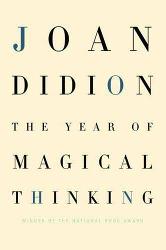
The Year of Magical Thinking, by Joan Didion


The Year of Magical Thinking
Joan Didion

At this point, most people are familiar with The Year of Magical Thinking, Joan Didion's attempt to come to terms with the grief she experienced following the death of her husband and near-fatal illness of their daughter in December 2003. I was also familiar with the general premise, but I was still unprepared for what awaited me. Didion's memoir is a clear analysis of what happens to someone after losing the most important person in one's world.

I had been wary going in to the book, as I am naturally suspicious of anyone who is able to profit from grief (this probably stems from "Professional Widow," a song by Tori Amos). This does not mean I belief grief should be private, swept under the rug, but I'm not sure I'm comfortable with someone whose grief is able to win not only the National Book Award but also lots of money in the process. However, Didion cannot help being a successful writer, and it is natural that one should turn to writing during such a time.

I have read many reviewers which criticized Didion for "name-dropping" in the book (for example, after John's death, she had dinner with so-and-so; while driving down this street in LA she was reminded of going with John to work on so-and-so's screenplay), but to be honest, I didn't recognize a single name she mentioned, so I wasn't really bothered by it. Again, she cannot help being a successful writer and knowing other successful people.

Other reviewers didn't like her lifestyle, one which is clearly upper-class: she and her husband frequently traveled the globe: Paris, London, New York, Los Angeles, and back again. However, I didn't feel she was rubbing her riches in the reader's face, as some critics have suggested; rather, Didion mentions their travels as a way of illustrating her plight: traveling almost everywhere with her husband, every major city is thus fraught with memories--is there any place on earth that will not remind her of her loss? Didion's wealth is just another reminder that money and fame do not keep tragedy at bay--we are all equal when it comes to loss.

Unfortunately, what Didion didn't know while writing the book, was that more grief was to come. Although Quintana nearly died, after a few months of recovery, it appeared she had fully recovered. This was not to be the case. Quintana died suddenly about a year following her recovery, just as this book was being published.

Illumination Factor: High. We must all face death at one time or another, and its always good to have the words of someone who suffered the same grief. However, Didion does not (in fact, cannot) offer a cure-all, a way to magically heal the pain that the death of a loved one visits on the survivor. The Year of Magical Thinking is instead one woman's way of reaching out to the world, to let other grievers know they are not alone.

In a nutshell: A work that is not altogether uplifting, The Year of Magical Thinking looks at grief head-on, and analyzes the crazy thoughts and feelings that go along with it. A book that will--unfortunately--be necessary one day.

Bibliolatry Scale: 4.5 out of 6 stars

Saturday, June 03, 2006

A Child Called "It", by Dave Pelzer

A Child Called "It"
Dave Pelzer

This is one survivor's tale of horrific child abuse. David Pelzer and his younger brothers enjoyed an idyllic existence, until, one day, for no reason at all, his mother began to abuse Dave. Treating her other sons as princes, she singles out her oldest son as "the bad boy" who is the source of all her problems. She starves him daily, forces him to drink ammonia, burns him on the stove, puts him in a homemade "gas chamber," and even stabs him. I didn't even give it all away.

This torture lasts for years, as his father weakly looks on, too intimidated to step in and save his little "tiger." In time, his younger brothers come to believe that Dave truly is a monster, and participate in his abuse.

Years pass, and Dave becomes an outcast at school: he is rarely allowed to bathe, so he stinks; he is rarely allowed new clothes, so his are worn with holes; he is rarely allowed to eat, so he steals from other students' lunches. FINALLY, years after this torture began, school personnel take notice and report Dave to the authorities, who free him from his mother. He ends up becoming the third worst case of child abuse in the state of California.

This is a short book; it can be read in about an hour or two, depending on your reading speed. It is a simply told tale that reminds us never to allow suspicions of abuse to pass quietly by. However, one problem with the book is its cover: it appears to be a cheesy book on self-help or new-age spirituality, instead of the moving tale of survival that it is. Check it out:


If I didn't already read about the book, I wouldn't be tempted to pick it up on its own. True, you should never judge a book by its cover, but lame covers don't help. In a time when the James Freys of the world have cast a doubt on memoirs, having a cloud-hand touching a child's chin does not add to one's credibility. That is not to say I disbelieve a single word of his book; in fact, there are letters from teachers and administrators who finally saved Dave which add legitimacy to his tale. Because of the serious nature of A Child Called "It", the book deserves a serious treatment. So ix-nay on the oud-hand-clay.

My other gripe with the book is that we never learn WHY the mother changed from being perfect and loving to awful and full of hate. Is she schizophrenic? On drugs? Abused herself? We don't know. OF course, there could never be a justification for her behavior, but I'd like to hear something. Maybe that comes in part 2, explaining Dave's teen years in foster care. Or part 3, discussing Dave's adult years.

In a nutshell: Not for the faint of heart, but at least you know he survives to tell the tale.

Bibliolatry Scale: 4 out of 6 stars