Showing posts with label Gothic lit. Show all posts

Monday, December 06, 2010

Back from the dead.

SO, life, in all its wonders has intervened since my last post many eons ago.

Life + stress + work = no time for blogging -- which figures, because I totally killed the RIP challenge. Of course I would be too busy to gloat recap the first time I've ever successfully completed a challenge.


SIGH.


So, anyway, here's a bunch of stuff I've read lately in order of awesomeness:


Outlander, by Diana Gabaldon
  • SASSENACH! GAH JAMIE I LURVEEEE YOU. Why are you so hot and yet so fictional? WHY OH WHY are there no magical rocks that can buzz me backwards in time?? (Also, why do they not smell? Because the entire time, I just kept thinking that everyone must stink to high heaven.) Anyway, they gave this shit away for free on Amazon. HELLO, THIS BOOK IS WORTH ITS WEIGHT IN GOLD. How dare Amazon give this gem away for free? Anyway, completely insane and completely awesome. I immediately finished it and downloaded the second book in the series. Jamie Fraser 4eva!!1


The Gates, by John Connolly
  • Short, lovely little tale about the gates of Hell opening up in someone's basement. And, there's Nurd, who's actually a lovely little demon. Charming and fun.


Dark Harvest, by Norman Partridge
  • This one was nice, fast, and spooky. Oh, and it qualified for RIP, for what that's worth. Some pumpkin kid comes to life and the town's teens have to destroy him before Bad Things happen. Note: It was much better than I'm making it sound.


Neverland, by Douglas Clegg
  • This one was atmospheric, Southern Gothicky, and a little disturbing. Isolated children get up to no good and they may or may not be making sacrifices to the devil. And then Bad Things happen. Also, RIP. This one was pretty good, although it didn't ruffle my muffin or anything.


Dead City, by Joe McKinney
  • Apparently this one's about zombies, although I needed google to remind me about that. Still, it was a good story and got me through more than a few goes on the treadmill. Also, not a total bummer of an ending. And, RIP.


33 A.D., by David McAfee
  • This one involves vampires and Jesus. Apparently vampires were the ones responsible for the crucifixion of Christ. Who knew? Actually not as bad as this sounds, although there's a reason it's at the bottom of this list. But still, vampires + Jesus, so take from that what you will. And, RIP.


Finally, I'm also reading like a dozen other things that I've stopped about halfway though because Gabaldon and her web of fantasy have rendered me impossible to read like a normal adult. And, that life thing again.

Hopefully normal posting will resume soon.


Monday, October 04, 2010

Ethel, I think you underestimated your transmitter!

The Seance
John Harwood

Can I just say how much I LOVE this time of year? True, the fall also coincides with a return to work which is, of course, full of UGH, but even a return to grading and poorly constructed sentences and forgotten homework can't make me entirely dislike autumn. AND, it's time for SPOOKY READS! Which are, of course, full of win.

So, you might remember John Harwood from The Ghost Writer, which was, as I recall, "a pretty good time." Now he's back with The Seance, an equally atmospheric Gothic mystery set in Victorian England.

Constance Langton has problems. Her father doesn't care about her, and her mother is too busy mourning her dead sister to care much about her, either. Constance begins to delve into the nascent spiritualist community in hopes of helping her mother move on from her grief.

Whoops. So much for THAT. The best of intentions, and all that. Before you know it, Constance learns she has inherited Wraxford Hall, a mouldering old mansion in the countryside, from a distant reputation. The lawyer who tells her of this inheritance warns her to sell the building without setting foot in it -- it has been the site of numerous apparitions, disappearances, and deaths. The Hall remains shrouded in mystery.

But this wouldn't be an entertaining novel if Constance were to listen. Soon she finds herself searching for the truth behind Wraxford Hall.

The Seance is a nice little novel that is both spooky and endearing. My only complaint is that I had a hard time envisioning some of the action (especially as the mystery was explained); however, this confusion is probably due to my unfamiliarity with the layout of such great homes. (Also, I was reading on my Kindle while walking on my treadmill. So I'm sure that didn't increase my comprehension. Oh well.)

In a nutshell: Charming, spooky, mysterious -- great fun.

Bibliolatry Scale: 5 out of 6 stars

FTCBS: Personal Kindle copy here

RIPV: Ghosts, seances, and a mystery? You're darn right The Seance counts toward this year's RIP challenge. BAM!


Sunday, October 03, 2010

Want to cure an obsession? Get another one.

Dr. Haggard's Disease
Patrick McGrath

Oh, Mr. McGrath. You are so wonderful. So literary, yet so Gothic. You tax my brain at the same time you chill my spine. How I love you.

Anyway, not so long ago (or almost two years!? insert obligatory lament re: time flying, and all that), I read a wee little tale called Asylum, and my love for Patrick McGrath was born. Alas, I had not the time nor the insight to seek out more of his work -- until now. Now that I've read my second McGrath, it's nearly all I can do to stop myself from buying every single thing the man's ever written. SO. GOOD.

Ok, so - Dr. Haggard's Disease. Dr. Haggard, injured and alone, has retired to a gothic manor to obsess over his lost love. As a young doctor, he had a brief but torrid affair with Fanny, the wife of a senior staff member. Unfortunately THINGS HAPPEN, and now Dr. Haggard is, well, a bit haggard. Now Fanny-less, he pines for his lost life -- until he receives a visit from Fanny's young son. And then he gets REALLY WEIRD.

In a nutshell: Love. Obsession. Addiction. Haunting, rhythmic prose. A crumbling seaside mansion. What's not to love?

Bibliolatry Scale: 5 out of 6 stars

FTCBS: This one's all mine. And so shall every other McGrath out there. You've been warned.

RIPV: Thanks to its Gothic nature, Dr. Haggard's Disease most definitely counts toward this year's RIP challenge. I'm killing this challenge! KILLING IT!


Monday, November 23, 2009

Rachel, my torment

My Cousin Rachel
Daphne DuMaurier

I've been meaning to post about my lastest encounter with the late, great Daphne DuMaurier. Not too long ago, I read Rebecca, and I was floored. I knew I had to read something else by this author, and when I found a discounted version of My Cousin Rachel, I knew fate was on my side.

It wasn't long before fate and I had yet another run-in, this time during one momentous day in October when I was called for jury duty. Thankfully, I remembered my new friend and brought her along for the day. We had a wonderful time together, as we eagerly anticipated hearing each subsequent round of suckers jurors who were next up. I dodged a bullet that day, but if it weren't for the experience, I might not have been able to read My Cousin Rachel. Each hellacious hour was filled with this spellbinding story, and while reading I was able to imagine that I was far from the courthouse that day.

Instead, I was on the estate of Philip Ashley (AKA Idiot Who Needs a Smack in the Head). Philip, who has been raised by his cousin Ambrose, looks back on his life and the choices that have brought him to this moment. Idiot takes us back in time, to a time when Ambrose was still alive. They loved one another. A lot. (But not like that -- jeez.)

At any rate, they love one another so much that Idiot fairly falls apart after Ambrose passes away. Ambrose, a confirmed bachelor (I'm pretty sure he likes to spit on the floor in the face of encroaching femininity or some such) goes off to Italy for a little healthification. While there, he meets his cousin Rachel, whom he -- previous misogyny be damned -- quickly marries. Unfortunately, the happy groom's health takes a turn for the worse, and it isn't long before he's dead. When Cousin Idiot learns the news, he is crushed.

Right: Olivia deHavilland as Rachel squares off against Richard Burton as the Idiot

Impetuously, he blames Rachel. But when he inherits the entire estate, it becomes clear that Rachel has no financial claim on anything. Perhaps his blame was hasty. But then Rachel returns to England, and all sorts of shit hit the fan. Philip is soon torn apart by powerful, conflicting forces: he falls in love with her, but also believes she had a hand in his cousin's death. Plenty of evidence support each side of the argument.

Was Rachel guilty? Did she poison Ambrose -- and does she mean to do the same to the idiot? One can only hope! (He's dumb enough to warrant it.) But don't worry about him: he's got a fool-proof plan for flushing her out into the open. Only, not. Read the book and be flabbergasted at that genius ending! Brilliant!

In a nutshell: The ambiguity! The uncertainty! DuMaurier, you've done it again.

Bibliolatry Scale: 6 out of 6 stars

FTCBS: I bought this one meself, so la la la lala.


Tuesday, June 30, 2009

I will not make a finger joke, I will not make a finger joke, Iwillnotmakeafingerjoke

Fingersmith
Sarah Waters

Sarah Waters is one of those authors I often hear praised, but yet have never read myself. After a respected fellow booklover (Nymeth from things mean a lot) told me to read Fingersmith, I thought I could excuse myself from my darned resolution to try a little Waters. AND THANK HEAVENS I DID.

Fingersmith is many things -- thriller, mystery, Gothic romance -- but the one thing it's not is predictable. Just when you think you've put your finger on it (sorry, I could only hold out so long...just count your blessings it wasn't a worse finger joke, cause I have a few), you find out you're wrong.

First, a warning: If you think you're interested in this novel, I'd stay away from any online summaries. I read them after the fact, and they give a wee bit more information than is strictly necessary. I only read the book's back cover, and that suited me just fine. Anything more is too much.

A quick, spoiler-free overview: Sue Trinder is an orphan raised by thieves in Victorian England. Despite the excitement of living outside the law, life really picks up when "Gentleman," a member of their merry band, arrives with a plan to make their fortunes. His plan is simple: dupe a rich girl into marrying him, then dump her in a madhouse. Sue, acting as maid to said rich girl, is to aid Gentleman's plot by talking him up. It won't be long before the marriage is legalized and the riches are shared. Huzzah!

Of course, it won't be that easy. I could say more, but in this case, I think the rest of the plot is better left unsaid. What follows is a complex and intricate plot that twists and turns much like Sue's native Borough. This hefty novel (about 600 pages) flew by in quick gulps, and I finished it faster than novels half its length.

True, it's not perfect: there were a few elements I'd like better explained at the end, and a couple things that didn't really make sense to me, but these trivialities pale in the face of the novel's entirety. My biggest complaint is that I didn't read it in the fall, because it would be perfect in October thanks to a hefty dose of fog and mist, a dark and oppressive English manor, one or two madhouses, and, of course, the cramped and dirty streets of London. Did I mention the fog?

In a nutshell: With its gorgeous prose, riveting plot, and enthralling characters, Fingersmith delivers on all counts. Now, the only question that remains is, which Waters' novel should I next read?

Bibliolatry Scale: 5 out of 6 stars


Wednesday, April 01, 2009

Manderley!

Rebecca
Daphne DuMaurier

Despite my glee at April's arrival, I'm grumpy. Why? I didn't purchase a new copy of Rebecca, one of the latest titles in my reading resolution. Instead, I bought a used copy, thinking I wouldn't really care about having an old and used one.

Unfortunately, I was wrong. I've fallen in love with this most-amazing book, and now I'm pissed that I don't own a better copy. Also, I'm angry that I totally sucked on this resolution this month. And, not surprisingly, I'm behind in my reviews.

But I digress.

I feel as though I'm the only one who didn't know the story of Rebecca, so a summary probably isn't necessary. If you're one of the few left alive that hasn't raved about this book, allow me a brief recap: our young narrator has just married the man of her dreams: the rich and mysterious Maxim de Winter. Things aren't so peachy, however, after their return to the de Winter estate, Manderley. Mrs. de Winter finds it impossible to run such a large household, and it seems as though she's doomed to fail. Even worse, the housekeeper, Mrs. Danvers, seems to hate her, her husband seems to be hiding something, and everywhere she turns, she is haunted by Rebecca, the first Mrs. de Winter who died a year before. You may think you know what's really going on -- but just wait. The suspense slowly builds until the mysteries of Manderley are unveiled in a stunning, surprise ending.

For years, I had heard Rebecca was good, but I didnt realize it was THAT GOOD. I couldn't put it down. I read while working, during eating -- even in the car (hubby was driving, obviously). Upon finishing the novel, I felt engulfed by the sadness one only feels at the end of a rare, amazing book. I could go on -- in fact, I can't say enough good things about Rebecca -- but now that I'm so far behind in both reading and reviewing, I haven't the time. Suffice it to say, if you haven't yet read this novel, do so immediately -- I can't imagine you'll be disappointed.

In a nutshell: Suspenseful, gorgeously written, utterly un-put-down-able -- Rebecca is a glory of a novel.

Bibliolatry Scale: 6 out of 6 stars


Tuesday, November 06, 2007

Serves you right, fools

The Haunting of Hill House
Shirley Jackson

I always wonder to myself: If I had the opportunity to spend a night in a "haunted" house, would I go? I say so in theory, but would I really? Somehow, I think I'd chicken out. Visiting is one thing, but spending the night? Isn't that just asking for trouble? And when you tempt fate, don't be surprised when you get bitten in the ass. So, to the characters of Shirley Jackson's novella The Haunting of Hill House, I say serves you right.

The novella begins as Dr. Montague seeks people to assist him in studying Hill House. He wants to document evidence of supernatural phenomena, and he seeks those with some history of involvement with the paranormal. Despite the dozens of invitations he sends, only two assistants arrive at the door to Hill House: Eleanor, a shy and lonely woman who has recently been freed from servitude by the death of her mother, and Theo, a sophisticated lady who can pick up on the emotions and thoughts of others. Along with them is Luke, the nephew of the owner, there to keep an eye on things. The four of them plan to spend the summer in Hill House and see if the rumors are true.

And what, exactly, are the rumors? It’s true the house has a checkered past – lots of “accidental” deaths and even a suicide or two – but nothing that clearly proves the house is evil. Of course, there’s the unfortunate connection between “Hill” and “hell,” but that isn’t proof of the supernatural. And just because no one will go there after dark might be just out of respect. At any rate, the house is huge and impressive, and the rooms within rooms adds to the claustrophobic effect by making it difficult to find one’s way around. The house consumes its inhabitants.


okay, maybe I'd take a little evil if it meant living here


Despite the overwhelming sense of claustrophobia, nothing much happens at first. Doors close that were left open, but perhaps that’s just due to the odd geometry of the house. As the doctor explains, every angle in the house is wrong, creating a “large distortion” in the house. Soon enough, however, more sinister occurrences happen, and it becomes increasingly difficult to explain these events as purely innocent, especially as the suffocating nature of the house causes cracks in the psyche of each inhabitant.

However, it soon becomes clear that Eleanor is targeted in a different way than the others. This isn’t totally unforeseen, since she has from the beginning of the book repeated a line of poetry to herself over and over: Journeys end in lovers meeting. Perhaps that’s not the best sentiment one can feel upon meeting what is commonly assumed to be an evil place.

Eleanor is certainly affected differently than the others, and no wonder: she is all alone in the world, and it is her loneliness and need to belong that mark her as more susceptible to Hill House than the others. She becomes enmeshed in a world of illusions, and at times the reader finds it difficult to separate what is actually happening from what Eleanor is imagining. Are the others turning against her? Or is the house infiltrating her mind? And what will become of her -- can she withstand the onslaught of Hill House?

In a nutshell: An excellent psychological ghost story; it's a must for fans of Jackson or for anyone who enjoys a good, unnerving tale.

Bibliolatry Scale: 5.5 out of 6 stars

Monday, July 09, 2007

Reality’s always better when it’s made up

Northanger Abbey
Jane Austen

Catherine Morland is a girl after my own heart. She loves a good novel, especially a good Gothic romance. Unfortunately, her propensity for such literature colors her perception of reality, adding an overactive imagination to an existing naiveté. Because she so wishes to see herself the heroine of a great Gothic romance, she often finds conspiracies where there are none and frequently misreads people’s motivations.

But we can’t really blame her. How many times do people view life through the lens of their favorite songs, television shows, and movies? Hopefully readers of Bibliolatry are more influenced by their favorite books, but as Jane Austen proves, doing so is hardly preferable.

It all begins when Catherine Morland is invited to vacation with family friends. An innocent seventeen-year-old girl, Catherine is often at a loss in Bath and frequently misreads the social situations in which she finds herself. She immediately falls in love with Henry Tilney but remains unsure as to his feelings for her. Soon, however, she befriends his sister as well – their happy friendship culminates in her visit to the family estate, Northanger Abbey.

A real abbey! To say Catherine is excited at such a prospect would be an understatement. She views such an excursion as an opportunity to experience a real Gothic setting. Catherine wants nothing more than to explore the old abbey and discover its secrets. But what secrets does it hide, if any? Is there a great mystery lurking at the heart of Northanger Abbey, or is Catherine simply confusing fiction with reality? What about Mr. Henry Tilney – does he truly love her, or is she simply romanticizing a rather mundane friendship? And what will become of the silly girl who sees secrets, plots, and omens everywhere she turns?

Of course, an Austen novel would not be an Austen novel if it lacked her famous social commentary, which is thankfully not lost here. But while Austen criticizes the social hypocrisy and false flattery that ran so rampant back then (as it still often does today), one might say the social commentary takes a backseat to Austen’s critique of the Gothic genre.

To put it simply, Northanger Abbey is a novel for those who love novels, especially Gothic ones, and even though I’ve already set two summer challenges for myself one involving poetry and one involving my bought-but-ignored books, reading Northanger Abbey has inspired me to add yet one more challenge.

I hereby declare that the summer of 2007 will also be known as The Gothic Summer. Even though I’ve labeled several modern works as Gothic (check out the Gothic Lit label to the right if you’re interested), I’ve only reviewed three truly classic Gothic Lit novels: The Monk, The Woman in White, and The Castle of Otranto. Before the end of the summer I also plan to add The Italian and The Mysteries of Udolpho by Ann Radcliffe as well as The Necromancer by Peter Teuthold.

If I’m missing a great read which you feel should be added to my Gothic Lit Challenge, please leave a comment and let me know. Hopefully I haven’t bitten off more than I can chew with all these challenges I’m setting for myself. Oh well. Thankfully failure is always an option.


Don't ask me; Rummy appeared when I did a GIS on "failure is an option."
There's a joke here, but you go ahead instead.


In a nutshell: Fast, fun, and funny, with a few spooks thrown in along the way. A must for Austen fans, Gothic lit fans, and just plain "good-book" fans.

Bibliolatry Scale: 5.5 out of 6 stars

Friday, June 22, 2007

This goth chick is a pretty good time

The Ghost Writer
John Harwood

John Harwood has achieved something I’ve long been waiting for: a story that chills for being spooky at the same time it pleases for being well written. What a novel idea! The Ghost Writer is an engaging tale told in the tradition of Henry James, and sure enough, allusions to The Turn of the Screw and Dickens enhance the novel. To be sure, The Ghost Writer contains far more than meets the eye.

Speaking of which, there lies my only complaint: not with the book, but rather with its packaging. Was this the best they could do? Where did this goth chick come from? The cover does a poor job of illustrating the novel’s essence by failing to portray the depth of the tale contained therein. Should one judge by appearances alone, a great novel would be missed.

(Not to beat a dead horse, but here and here are two others and I don’t see why a change for the worse was necessary when these two speak perfectly to the novel without being hokey. Okay I'm done.)

The Ghost Writer explores the coming-of-age of one Gerard Freeman as he seeks to understand his mother’s history, a history that has been kept from him his entire life. Gerard’s first memory is of sneaking around in his mother’s room and finding some hidden papers in the bottom of a drawer. He had just begun to read when his mother descends, delivering a rapacious beating for snooping. Gerard wants to know more about his mother’s life in England and her reasons for moving to Australia, but she steadfastly refuses to answer his questions beyond what little she has allowed him to know.

What Gerard does know is precious little: that his mother, Phyllis, was an orphan, her parents killed in an accident when she was a little girl. That Phyllis was raised by her grandmother, Viola. That Viola had been a writer of ghost stories. The novel's action artfully weaves these truly creepy supernatural tales with letters from Alice, a childhood penpal who was paralyzed and orphaned in a horrible accident in England. With his only friend half a world away, Gerard lives a lonely life, consumed by his desire to know his past.

The novel suspensefully chronicles Gerard's search for the truth and provides plenty of spooks along the way; I stayed awake long into the night just to finish it, vowing not to go to bed until I had learned all its secrets. And while I anticipated a couple of plot points, there was enough I hadn’t seen coming to leave me feeling satisfied. In fact, it's really a work that bears a second reading after all the facts are known.

In a nutshell: Smart and spooky. It's a go here.

Bibliolatry Scale: 5.5 out of 6 stars

Sunday, January 21, 2007

The Big Secret Done Right: The Thirteenth Tale

The Thirteenth Tale
Diane Setterfield

I've been burned by misleading book reviews, so when a book is as hyped as Setterfield's Thirteenth Tale, I am more than a bit skeptical. I've read many reviews raving about the novel's unexpected secrets and unforeseen twists and turns. We'll see, thought I.

The novel begins as Margaret spends her time among the books in her father's bookstore. She has not much time for people, and she likes it that way. Her endless span of days spent reading and cataloguing is interrupted by a letter from the legendary Vida Winter, the nation's most beloved -- not to mention secretive -- writer.

Vida is old and ill and understandably desperate to tell the world the true story of her life, which she has successfully kept hidden for decades. The crux of Vida's story involves a lost twin, a situation Margaret understands. As Vida's complex past unravels, it soon becomes clear that her story is quickly rushing headlong toward the unveiling of a Really Big Secret. In fact, it seems that adding a Really Big Secret to your under-appreciated novel will guarantee it all sorts of attention and acclaim (c.f. The Keep by Jennifer Egan for a good example of a bad novel getting excellent press due to a "surprise." Brilliant use of the technique, really.)

In fact, these two novels have a lot in common. Besides their mysteriousness, both novels feature Gothic elements, ghost-like characters, a writer seeking to uncover the truth, and, of course, a Really Big Secret. The main difference, however, is that Egan's secret is like a fart in an elevator: all up in your face and impossible to conceal. In a nice contrast, Setterfield's secret is deftly obscured until the very end; while I kept trying to guess it, I never once came close.

In a nutshell: Pretty good for a hyped bestseller. Thankfully the first chapter is the only one in which she begins every other sentence with the word "for." For I could never forgive an entire novel of such overwrought, melodramatic rubbish.

Bibliolatry Scale: 4 out of 6 stars

Wednesday, November 08, 2006

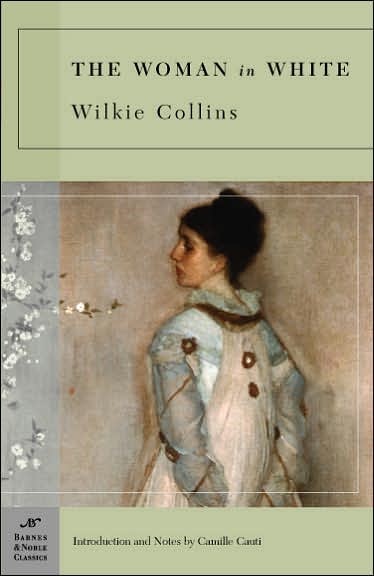
The Woman in White, by Wilkie Collins

The Woman in White
Wilkie Collins

My lack of posting recently has been due to the behemoth called The Woman in White. At first I was daunted by the novel's 600+ pages, and I feard that its length presaged a boring work. I needn't have feared. The Woman in White is not only a classic of literature, but also the most impressive, satisfying "mystery thriller" I've ever read. DaVinci Code, indeed.

Admittedly, The Woman in White began somewhat slowly, but by page 50, I was hooked. The story mainly involves, not surprisingly, a woman in white encountered by the first narrator at the novel's onset. Who is she? Why does she only wear white? What is her terrible secret? The first two questions are answered fairly early in the novel, but don't expect an answer to the last until nearly the end.

The novel has many strengths, and not many weaknesses. The structure of the novel is particularly compelling; our first narrator is Walter Hartright, who narrates the story until he can no longer narrate it. Marian Halcombe continues it, until she no longer can, and so on. This technique advances the plot while maintaining a high level of suspense. I soon found myself reading for hours on end, despite having more pressing concerns, just to find out what would happen next to these fascinating characters.

These characters are, in my mind, the other great strength of the novel. What reader doesn't feel admiration for the ugly, manly Marian Halcombe? Who isn't utterly enchanted by the gallant, the obese, the utterly villainous Count Fosco? The world needs more Count Foscos, regardless of his lack of morality. I think I will name something Fosco. Maybe my next dog.

The only weakness I could find in the novel is a minor weakness at that. The "falling action" if you will, drags on a bit, and in an effort to tie up some loose ends, some elements seem a bit contrived. However, such is often the case when it comes to the genre, and it wasn't contrived enough to warrant an indignant outburst on my part. I finished The Woman in White content and pleased in my reading.

In a nutshell: If you enjoy a good mystery, you owe it to yourself to read The Woman in White. Who doesn't love a big, fat Count who loves his white mice and cream puffs?

Bibliolatry Scale: 5.5 out of 6 stars

Wednesday, October 18, 2006

The Castle of Otranto, by Horace Walpole

The Castle of Otranto
Horace Walpole

As "the earliest and most influential of the Gothic novels," I felt compelled to read The Castle of Otranto, especially as I love the genre. And, at about 100 pages, it wasn't difficult to tear through this classic novel.

The novel begins with the impending wedding of Conrad, son of Manfred (the prince of Otranto). Unfortunately, Conrad has just been killed by a giant...wait for it...helmet. Yes, a giant helmet. Conrad's death leads Manfred to set in motion a sequence of unhappy events, which all just so happen to illustrate the conventions of Gothic literature.

First, there's a damsel in distress and a domineering, lusty man who places her in peril. Then there's a spooky castle with secret passages, complete with a ghost or two. Add in a prophecy, a little insanity, a death or two, lots of swooning and fainting, and there you have it.

Unfortunately, like most melodramatic novels, the plot is contrived and the ending can be seen a mile away. Another gripe I had was the dialogue: instead of each speaker's words being separated from another's, it was all lumped together in one paragraph; quotation marks were not even used, which made it quite difficult to tell when one person finished speaking and another began. My final complaint was that it wasn't really scary or scandalous, especially compared to my favorite Gothic novel, The Monk.

In a nutshell: The Castle of Otranto is a must read if you enjoy Gothic literature. If you haven't been introduced to the genre, this is a fun, quick way to see Gothic lit in action. It isn't, however, the best book you'll ever read, but, c'mon - the guy got killed by a giant helmet.

Bibliolatry Scale: 3.5 out of 6 stars

Tuesday, October 10, 2006

The Keep, by Jennifer Egan

The Keep
Jennifer Egan

Einstein famously said, "Imagination is more important than knowledge," but is that true? How important are "facts," really? How powerful is one's imagination? Jennifer Egan explores this theme as well as the illusion of freedom in her second novel, The Keep, in which two stories are interwoven and connected by the unknown.

Danny, drawn to his cousin Howie's newly-acquired castle due to various unpleasant circumstances, finds a mystery he cannot unravel. As his cousin and his workers renovate the castle, Danny finds the old baroness holed up in the keep, the strongest part of the structure. The baroness refuses to leave the estate that has been in her family for nearly a thousand years. Even more mysteriously, she seems to change and shift, at times appearing as a beautiful young lady even though she is nearly a century old. What exactly is going on at this castle? Danny, cut off from life back home (there are no cell phones, internet connections, or satellite dishes here), desperately tries to find himself and reconnect to the world.

Meanwhile, as Danny narrates his adventures at the castle, another man narrates his tale: Ray, in prison with no possibility of parole. To escape the dreariness that surrounds him, he begins to write. One can obviously draw parallels between Danny and Ray just from what I've written here. However, the real surprise is the way in which their stories finally do collide, and it is this mystery that is at the real heart of the novel, not the goings-on at the castle.

While I found this book to be a real page-turner, something prevents me from rating this book as greater than mediocre. It is undoubtedly an enjoyable read, but does not deserve the heaping praise delivered by some reviewers. And yet, I'm not sure why--perhaps it is because The Keep is a bit formulaic in parts, simply unnecessary in others, heavy-handed in still others.

In a nutshell: Pretty good for popular fiction, but too contrived to be more than that. As a page-turner, The Keep's final surprise will compel you to get to the end, but it won't resonate with you after it's over.

Bibliolatry Scale: 3.75 out of 6 stars

Tuesday, August 15, 2006

The Secret Life of Laszlo, Count Dracula, by Roderick Anscombe

The Secret Life of Laszlo, Count Dracula
Roderick Anscombe

Her hand was pale and perhaps a little cold, but the white damask tablecloth brought out the hint of pink at the knuckles and the fingertips, and there was such a soft succulence about the limb that I was seized with the notion of biting into the fleshy bulge of the thenar eminence, of sucking at it, biting deeper until my teeth encountered the grit of fascia and tendons and could go no farther. Is that grotesque?...If we can be transported with delight by such a vegetarian pleasure as sinking one's teeth into the summer's first peach and feeling the sweet juices overflowing the lips and dripping off one's chin, how then can we frame the magnitude of pleasure that may flow from devouring a maiden's hand? I cannot believe I am alone.

Are you loving it? "Is that grotesque?" he asks! Who doesn't love a murderous aristocrat with a penchant for partially devouring his victims?!

This is the journal of Laszlo, Count Dracula. But it is no supernatural vampire who writes these pages; instead, it is simply your everyday, run-of-the-mill psychopath. The author's portrayal of the mind of a lunatic seems scarily accurate, and it is: Anscombe's a criminal psychologist whose patients inspired Laszlo's criminal mind.

For his part, Laszlo isn't such a bad guy, really. Well, okay, he likes to murder young girls and taste their blood. But he does feel really bad about it; his desire to kill is a compulsion which he cannot control. (You may, like me, catch yourself sympathizing with him a few times, before reminding yourself that he's a pretty big jerk.) Meanwhile, his townspeople believe him to possess saintly qualities and eventually touch the hem of his garment or kiss his hand out of superstition.

Will he get caught? Will he, tortured by guilt, turn himself in? As the murders increase, the facade of his innocence becomes increasingly difficult to maintain. But is the fear of getting caught enough to stop this murderer, or any criminal, for that matter? Unfortunately, Anscombe's glimpse into criminal psychology shows us that the thrill of getting caught is half the attraction.

In a nutshell: If you're like me, you won't be able to put The Secret Life of Laszlo, Count Dracula down. It's a page-turner, and an exceptionally well-written one at that (especially for someone who is not a writer by profession). Yet another reminder to go NOWHERE alone. And don't trust creepy Hungarian counts.

Bibliolatry Scale: 5 out of 6 stars

Sunday, April 16, 2006

The Monk, by Matthew Lewis

The Monk
Matthew Lewis

Now THIS is a good book!!! This is another in the way of Lolita and Watership Down, in that I’ve read it several times already—but it's another book that demands rereading every couple years. It’s just so damn good! Because of its high scandal factor I've wanted to teach it, but considering I teach in a Catholic school, the idea of a monk turned rapist and devil worshipper may not be such a good idea.

Oh please! I say. It’s not like it’s not relevant. Sometimes people are so uptight. This is classic literature, folks! And great literature at that.

The book’s main character is Ambrosio, who, as an infant, was abandoned and given to the order of the Capuchins. Raised by the monks, Ambrosio showed great promise even at an early age, and he soon took his orders. He becomes a figure of great piety—easy enough, when you’ve spent your entire life within the walls of a monastery. The only time he ever leaves is every Thursday, when he delivers a sermon to the massive crowds who come to see what they deem a living saint. During one of these sermons, his eyes light upon Antonia, a young girl of fifteen, who just so happens to be the most beautiful, most pious, and most innocent girl in existence. Filled with lust, Ambrosio vows to have her, and he will stop at nothing to do so. And that’s only the beginning!!

Yeah…so probably wouldn’t go over well in a Catholic school. Which sucks, because this is a book I can really get behind. First, it’s a Gothic novel, so there’s lots of creepy, crazy stuff. I also find it amazing that a book this scandalous was written in 1794. Also noteworthy is that Lewis wrote it before he turned 20, which of course makes me feel great that I’m a bit past that age and have nothing this awesome to my resume. The book is not all scandal and sensationalism, however. The book also raises interesting points on the true nature of piety. You cannot be truly pious if you hide from sin. Rather, you must face it daily and refuse it.

Granted, the book can be a bit melodramatic at times, but it's all in keeping with the genre. The melodrama can easily be overlooked in the presence of everything else that is so great about The Monk. On my now fourth read, I'm finding lots of ironic, funny lines I previously missed. And I never cease to be amazed at the depths to which the monk will sink so that he might have his desires. This is definitely a book that gets better with age.

In a nutshell: A fabulous, page-turning classic that gets better with every reading. You must read it, if you haven't already.

Bibliolatry Scale: 6 out of 6 stars