Saturday, July 29, 2006

Absurdistan, by Gary Shteyngart

(Warning: profanity ahead)

Absurdistan
Gary Shteyngart

Has anyone read this book? If so, can you explain what's so funny about it? Cause I read half of it, and I refuse to torture myself anymore during this glorious summer. This book fucking blows.

I rarely buy hardcover books. If I do, it better be worth my money. Unfortunately, my no-hardover policy prevents me from reading the newest books, causing me to wait months, even years, before the paperback version arrives. I thought: no more! I will read new releases! Bring on Gary Shteyngart!

Somewhere, God is laughing.

Ok so the story is about Misha, a rich, fat, Jewish Russian whose father is recently deceased. Because his father murdered an American, Misha is exiled in Eastern Europe, unable to return to America, the land of his dreams, his friends, and his love, a Puerto Rican stripper who (and, remember, I've stopped the book halfway through) appears to be using him for his money. The scenes are so tedious, so not funny, I'm surprised I got as far as I did.

The only funny part (when Misha raps) appears at the beginning of the book. It's this same section I read in a review - the same review that convinced me to buy the book, I might add. Unfortunately, the funny is discontinued by about, oh, page 10. And there's about 350 pages in the book. Oh, and all the characters are bloody boring cows, so it's not like you can cling to them, either.

In a nutshell: Take A Confederacy of Dunces, make Ignatius Russian, kill off both parents, and then SUCK OUT ALL THE MOTHERFUCKING HUMOR. Now you've got Absurdistan.

And now to top it all off I'm stuck with the hardcover.

Bibliolatry Scale: abandoned

Tuesday, July 25, 2006

Dear Zoe, by Philip Beard

Dear Zoe,
Philip Beard

On September 11, thousands died, although not all of those deaths were caused by hijacked planes and falling buildings. Tess DeNunzio's little sister, Zoe, died that day, and Tess tries to come to grips with Zoe's loss, her own place in Zoe's death, and the fact that Zoe's death will remain anonymous in the face of a national tragedy.

Dear Zoe, is a series of vignittes written by Tess, a fifteen-going-on-sixteen year old. Kudos to Beard for truly sounding like a teenage girl. Unfortunately, I found much of the second half of the book to be cliched and predictable. (However it is only the second book I've read which deals with September 11, albeit indirectly, so I guess that is something. Maybe.)

Illuminating? Not really. I was enticed to read the book because a snippet had appeared in a writing magazine. It seemed to have depth, to offer order out of chaos. I was suckered. The book was okay, but definitely lacked profundity. Perhaps if I had stopped reading after the first half, I'd think differently. Ho hum.

In a nutshell: Meh. If you don't have anything better to read, go for it. It's pretty short. I got the hardback on sale from barnesandnoble.com for about 2 bucks. That's saying something, no?

God, I feel like a jerkoff.

Bibliolatry Scale: 2 out of 6 stars (1 of those might be out of pity; I'm not sure.)

Monday, July 24, 2006

The Lovely Bones, by Alice Sebold

The Lovely Bones
Alice Sebold

The furor over The Lovely Bones has sufficiently died down enough for me to permit myself to read it. Hmpf! I thought. I don't read popular fiction. I read literature. Well, sometimes a popular book just feels good, even if it's a book narrated by a murdered girl.

For anyone still unfamiliar with the story, our narrator is Susie Salmon, murdered by a neighbor while she walked home from school. (This is not a spoiler; it's the first chapter.) She narrates the work from heaven, where she watches her family cope with her disappearance.

First, the pros. The Lovely Bones was surprisingly well written. I was shocked by the beauty I found in a few simple lines. The story was gripping, even though I had already heard countless people talk about the book, and I finished it in about a day.

The cons? There were a few. The ending was a bit formulaic for me, a bit too New Age in the "let's all get happy" kinda way. A couple of the scenes seemed a bit contrived. But these drawbacks are minor compared to the work as a whole.

Illuminating? In a way. There is much to be said for Sebold's vision of heaven, but the pessimist in me says not to be comforted by images of frolicking dogs or dancing relatives. There is much to be learned about letting go, but I'm not sure I'd be so forgiving if I were in Susie's position.

In a nutshell: Not perfect, but does justice to the label "popular fiction."

Bibliolatry Scale: 3.5 out of 6 stars

Thursday, July 20, 2006

Seven Types of Ambiguity, by Elliot Perlman

Seven Types of Ambiguity
Elliot Perlman

Can we ever truly know another person? Is anything ever unambiguous? These are just a couple of the questions Australian author Elliot Perlman tackles with Seven Types of Ambiguity. Unfortunately, it seems (and I must agree) that we can never really, fully know another person, not our spouses, not our parents, not even ourselves. No relationship can ever be unambiguous. Everyone always has too many secrets, too many private desires. Perlman will have you pondering the nature of every relationship in your life. Ah, what a glorious read.

This book has been described as a "behemoth" -- and, at over 600 pages, it is -- but such a label is misleading. It leads one to think that such a book is tedious, over long, and worse, boring. This book is none of those. I stayed up late reading it. I couldn't put it down. Unfortunately I was without power for over 24 hours; had reading by candlelight been as romantic as it's made out to be, I would have finished much earlier than I did. Quite simply, this is an amazing book. I defy someone to put this book down before finishing it.

The story is simple -- well...not really. Simon, unable to get over the woman who left him ten years before, kidnaps her son. Well, really he only picked him up from school, watched him for two hours, and gave him some chocolate milk. Pretty straightforward, right? Nothing is ever so simple. This "simple" story is complicated when told from the points of view of seven different narrators. Each one both forwards the plot and adds a new shade of meaning previously unknown. (By the way, this book is not to be confused with Empson's literary criticism of the same name, although Perlman frequently acknowledges his indebtedness to the work.)

Illumination Factor: This book will make you analyze each and every relationship you have. What do you know about the people in your life? What do you know about yourself? How much can we really be sure of? There is always so much that remains hidden, it seems silly to use the word "truth" at all.

In a nutshell: Seven Types of Ambiguity will not let you go until you've read the last page. You'll be glad you lost sleep or read until you felt ready to drop.

Bibliolatry Scale: 5.5 out of 6 stars

Tuesday, July 11, 2006

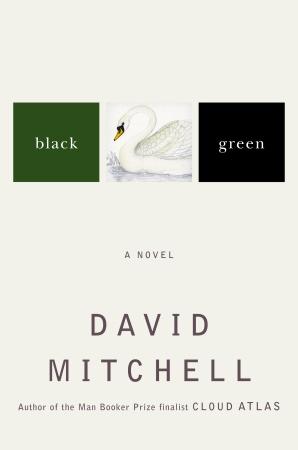
Black Swan Green, by David Mitchell

Black Swan Green
David Mitchell

Being 13 sucks. Being a stutterer sucks. Being a pariah sucks even more. Such is the plight of Jason Taylor, the narrator of Mitchell's latest, Black Swan Green. From Taylor's perspective, Mitchell explores the world of adolescent hierarchies. Sounds a bit like Prep, right? Yeah, a little, with two major differences: Black Swan Green is actually good, and David Mitchell can actually write. Oooh, burn. Yeah, I said it.

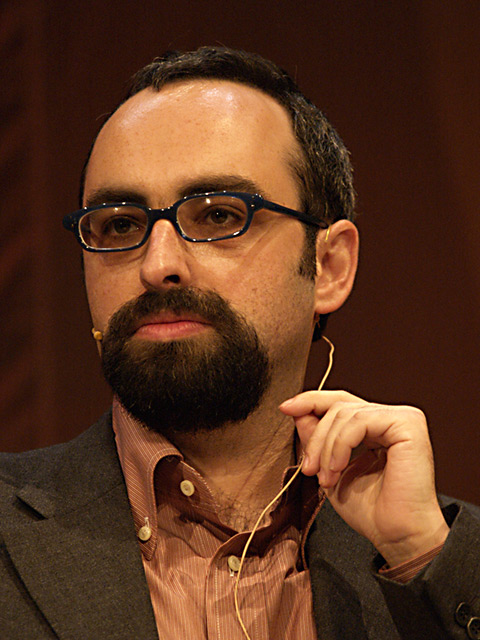
Black Swan Green is different from Mitchell's other works I've read (namely, Ghostwritten and Cloud Atlas) that featured shifting perspectives and multiple narrators. I was worried that the move to a single narrator would cause Mitchell to lose some of his appeal. Thankfully, it didn't. I'm glad to see he's not a one-trick pony. Instead, Mitchell appears to be at the top of his game, and I'm happy to proclaim him my favorite contemporary author. Just look at him. He's absolutely adorable. Too adorable to be straight, but we can hope, no?

Each chapter is a short story spanning a year in the life of Jason, a boy whose parents' marriage is disintegrating, whose school life is awful, and whose "Hangman" is constantly tripping him up with words he can and cannot say. Jason finds an outlet in his poetry. My only complaint with the book is that we don't get to read his poetry for ourselves. Usually I hate when authors write poetry for their characters (ugh, like in Possession), but I think it would have been acceptable here.

Illumination Factor: Jason Taylor is such an awesome kid. We could all learn a lesson from him. That doesn't mean the book is preachy. Thankfully, not at all.

In a nutshell: Another success for David Mitchell. If you haven't read anything by him, this is as good a place to start as any. I can't wait for his next work.

Bibliolatry Scale: 5 out of 6 stars

Thursday, July 06, 2006

Straight Man, by Richard Russo


Straight Man
Richard Russo

Ah, to be a college professor. Annoying students. Office politics. Budget cuts. I'm glad I didn't go for my Ph.D. If this is what being a professor is all about, forget it.

William Henry Devereaux, Jr. is English department chair for a small college in rural Pennsylvania. He seems to do very little teaching and instead deals mostly with his department, quelling worries that he is not looking to fire members due to budget cuts. In fact, he doesn't even have a budget. In a moment of spontaneity, Hank threatens to kill a duck a day (it's actually a goose) until he gets one. From there, things get worse.

Straight Man wavers from quite amusing (I think I laughed out loud once, although there were quite a few funny scenes) to quite introspective. While dealing with his departmental woes, Hank is also in the midst of a mid-life crisis. He is unsure if his chosen path is the right one. He hasn't written in years. He still lives in his father's shadow. To top it all off, he can't pee. Hopefully, it is nothing more serious than a kidney stone. Poor guy.

I enjoyed this book and its insight into the world of academia. My only complaint is that it left me a bit cold. I sympathized with a few of the characters (especially Hank), but overall I wasn't moved to the core, if you know what I mean.

Illumination Factor: I guess there's some in there if you dig around a bit, but this isn't a book I'd turn to for comfort or advice. This would probably make a good beach book, if I were into the beach.

In a nutshell: Meh. That about sums it up. Pretty funny, an overall okay book, but didn't make me want to read more of Richard Russo.

Bibliolatry Scale: 3.5 out of 6 stars

Saturday, July 01, 2006

The Year of Magical Thinking, by Joan Didion


The Year of Magical Thinking
Joan Didion

At this point, most people are familiar with The Year of Magical Thinking, Joan Didion's attempt to come to terms with the grief she experienced following the death of her husband and near-fatal illness of their daughter in December 2003. I was also familiar with the general premise, but I was still unprepared for what awaited me. Didion's memoir is a clear analysis of what happens to someone after losing the most important person in one's world.

I had been wary going in to the book, as I am naturally suspicious of anyone who is able to profit from grief (this probably stems from "Professional Widow," a song by Tori Amos). This does not mean I belief grief should be private, swept under the rug, but I'm not sure I'm comfortable with someone whose grief is able to win not only the National Book Award but also lots of money in the process. However, Didion cannot help being a successful writer, and it is natural that one should turn to writing during such a time.

I have read many reviewers which criticized Didion for "name-dropping" in the book (for example, after John's death, she had dinner with so-and-so; while driving down this street in LA she was reminded of going with John to work on so-and-so's screenplay), but to be honest, I didn't recognize a single name she mentioned, so I wasn't really bothered by it. Again, she cannot help being a successful writer and knowing other successful people.

Other reviewers didn't like her lifestyle, one which is clearly upper-class: she and her husband frequently traveled the globe: Paris, London, New York, Los Angeles, and back again. However, I didn't feel she was rubbing her riches in the reader's face, as some critics have suggested; rather, Didion mentions their travels as a way of illustrating her plight: traveling almost everywhere with her husband, every major city is thus fraught with memories--is there any place on earth that will not remind her of her loss? Didion's wealth is just another reminder that money and fame do not keep tragedy at bay--we are all equal when it comes to loss.

Unfortunately, what Didion didn't know while writing the book, was that more grief was to come. Although Quintana nearly died, after a few months of recovery, it appeared she had fully recovered. This was not to be the case. Quintana died suddenly about a year following her recovery, just as this book was being published.

Illumination Factor: High. We must all face death at one time or another, and its always good to have the words of someone who suffered the same grief. However, Didion does not (in fact, cannot) offer a cure-all, a way to magically heal the pain that the death of a loved one visits on the survivor. The Year of Magical Thinking is instead one woman's way of reaching out to the world, to let other grievers know they are not alone.

In a nutshell: A work that is not altogether uplifting, The Year of Magical Thinking looks at grief head-on, and analyzes the crazy thoughts and feelings that go along with it. A book that will--unfortunately--be necessary one day.

Bibliolatry Scale: 4.5 out of 6 stars

Wednesday, June 28, 2006

Shade, by Neil Jordan

Shade
Neil Jordan

Have you ever read a book that, after finishing it, made you ache for the beauty of it? Shade did just that for me, and it's been awhile since I've found a book this good, this unique. (Please comment with titles of "achey-beautiful" books if you've had this experience. I'd love to read more.)

At fifty years old, Nina Hardy is murdered by her childhood friend, George. This event, narrated with singular poetry by Nina's ghost, is presented to us on the first page; I ruin no surprises here. The point of this novel is not the murder itself but the history behind the act. What led George to slit Nina's throat, hack off her head, then hide her body where it would never be found? What monster could do this to his friend?

Our first impression of George the Monster is soon dispelled by Jordan's entry into the childhoods of four Irish children making their way in the world. As an only child, Nina lives in an imaginative world peopled by dolls and ghosts. She soon makes some real enough friends: Janie and her brother, George, poor kids who live behind her great manor. George is slow, dull-witted, but that doesn't stop them all from becoming fast playmates. Soon, Nina is joined by her half-brother, Gregory, and the group is complete. We follow these four characters from their earliest youths to Nina's murder fifty years later; only then do we learn the reasons behind George's actions. In the meantime, these characters endure war, grief, love (and what love! oh my, oh my!), and turmoil. We come to know these characters not as characters, but as people.

Stylistically, the book is a masterpiece, weaving narrators and periods together like a seamless tapestry. For anyone interested in writing, consuming Jordan's work with an eye to the technical is a must. Unfortunately, his narrative technique is something I could only marginally observe, so wrapped up was I in the beauty and poetry of the story, so I must return to this aspect of the book later.

For me, Shade was more about its beauty than its message. However, the novel is a good illustration that a horrific deed does not always mean the perpetrator is wicked. Over the course of the novel, we see the beauty of George's character, and we learn that not all monsters deserve such a label.

In a nutshell: A beautiful, surprising work. Shade reads like poetry at times, but is a mystery at heart. A must-read.

Bibliolatry Scale: 5.5 out of 6 stars


Saturday, June 24, 2006

Foucault's Pendulum, by Umberto Eco


Foucault's Pendulum
Umberto Eco

Well, I've finally read some Eco. Whoopee! Now I don't have to do it ever again.

Not that I didn't like Foucault's Pendulum. But did you ever see that episode of Seinfeld where Elaine wants to quit the group after finding a Bizarro Jerry, Costanza, and Kramer? In one of my favorite lines, she says: "I can't spend the rest of my life coming into this stinking apartment every ten minutes to pore over the excruciating minutia of every. single. daily. event!"

This book made me feel kinda like that.

Foucault's Pendulum is about 600 pages long--and I felt like it took the first 200 to really get going. It's filled with the minutia of every bit of esoterica ever assembled. From Cabala to the Templars, it's all here. I felt like I should have done a lot of reading just to prepare myself for what the hell Eco's talking about. And I've read Holy Blood, Holy Grail. I know (something) about Cabala. I've studied the pyramids of Egypt. I've struggled through The Golden Bough (for a grad course, not for fun). But Foucault's Pendulum involves this and more, much more.

So the story goes something like this: three editors of occult books, tired of hearing the rubbish continuously spewed forth from those interesed in all things extraordinary (and, of course, tempted by the prospect of selling a lot of books to the idiots who eat up these ideas), decide to come up with some theories of their own. A grand theory, in fact, that unites everything. And I mean EVERYTHING. Unfortunately, The Plan (as they call it) becomes real. Dum dum DUM!

The book was good, but I had read such raving reviews of it that I was expecting nothing short of the literary return of the big J.C. himself. Needless to say, I was disappointed. Foucault's Pendulum was *okay* - but instead of enjoying the read I'm just proud I can now say I've read Eco. He just sounds so literary. See:

Person: "What are you reading?"
Me: "I'm reading Umberto Eco's Foucault's Pendulum."
Person: "Oooh, wow. Sounds like quite a read."
Me: "Yeah, it's a little tough, but it's so worth it."

That last part isn't entirely true, but you don't want to necessarily admit that to someone who might be duped into trying the book on for size. Sucker!

Illumination Factor: Medium, if you can get past the long stretches of historical information. Basically (what irony) Eco seems to be saying that theories like those about the Rosicrucians, the Templars, alchemy, and so on are all trash. But they also provide the lost with something to believe in. In the absence of God, are these theories just as good? Oy vey. I don't know.

In a nutshell: Foucault's Pendulum is fun in parts. Unfortunately those parts are few and far between, and it just seemed like there was a lot of unnecessary junk strewn throughout it. I'll admit: I skimmed in some places. It didn't make much of a difference. But there's no denying that carrying it around makes you look ubersmart.

Bibliolatry Scale: 3 out of 6 stars

Wednesday, June 21, 2006

99 Ways to Tell a Story, by Matt Madden

99 Ways to Tell a Story: Exercises in Style
Matt Madden


Writers of all sorts can gain something from this book, so long as you know what you are getting into: this is not a book that will help every writer. More to the point, only a few pages will really be beneficial for most writers: but for those writers searching for some innovative techniques, even one helpful hint might make the book worth it.

The title says it all: Madden starts with a basic story and retells it 99 different ways...sort of. The basic template is as follows: Madden is working at his desk. He gets up and goes downstairs to the fridge. While he is en route, his wife asks him the time, and answering her question causes him to forget what he was looking for. The final picture looks like this:


Did I mention this was a comic? Yeah, I didn't know either until I got it. Nevertheless, there are a few interesting tidbits for a writer not interested in graphic novels. Unfortunately, many are limited to that medium alone. But as I said earlier, even writers of regular ol' prose can glean some knowledge from the variations Madden illustrates.

My beef? Not all are variations. Ok, so he gives the basic story. Then he retells the basic story from the point of view of his wife. That's a variation. Then he retells it as a flashback. Sounds like a variation to me. Then using all sound effects. Another variation!! Then he retells the story...the same as the template...except now Madden has become a knight. WTF? That's not a variation in style - he's just in costume. Or by using animals -- but keeping the same story. At any rate, some variations seemed less of a variation and more of a way to reach that elusive 99.

Illumination Factor: High, if you write comics. Medium to low if you write non-comic-book material. None at all if you don't like to read comics, write comics, or write anything.

In a nutshell: Mildly interesting and mildly helpful. As a writing teacher, there are a few things I can show in the classroom. I'm glad I bought the book used.

Bibliolatry Scale: 2 out of 6 stars

Tuesday, June 20, 2006

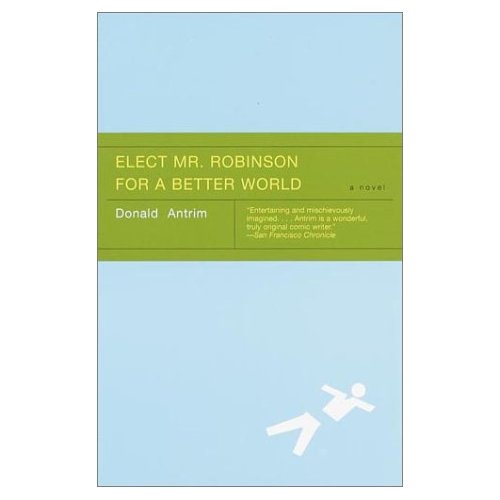
Elect Mr. Robinson for a Better World, by Donald Antrim

Elect Mr. Robinson for a Better World
Donald Antrim

The world is crazy in this surreal novel. Pete Robinson, teacher and expert on medieval torture techniques, wants to fix it, but he doesn't know that he is just as messed up as the rest of his community. He's the classic unreliable narrator--don't believe much of what he says. Through his eyes, Antrim delivers a trenchant social commentary about the evils of suburbia. And while I'm tempted to yawn "been there, done that," there were a few funny moments.

In this world, homeowners are suspicious of their neighbors, who might just be out to get them. They build deadly pits and moats around their homes. Parks are filled with landmines. The schools have been closed due to a lack of funding. People worship fish. (It's a seaside community.) In fact, most members of this community feel their "spirit animal" is a fish in nature; even Meredith, Pete's wife, believes she is a coelacanth (a prehistoric fish)--which sucks because Pete is a bison. Hm.

Because the town is so messed up, Pete decides he should be mayor. (In case you were wondering, the previous mayor had just been executed for killing some people. Thankfully, Pete was there to explain how to draw and quarter him correctly.) So, Pete decides to open a school at his home so that his students can get to work on his campaign. Needless to say, his plan doesn't end well.

Illumination Factor: Low. This was my first introduction to Antrim, and Elect Mr. Robinson for a Better World was amusing at parts, but I didn't feel as though I had gained anything new from it. Suburbia sucks. New Age religions are dumb. Violence begets violence. Ok, thanks. For what it's worth, the ending was great.

In a nutshell: A mildly-amusing, fast read, but won't change your life or teach you anything new. But again, it was a great ending.

Bibliolatry Scale: 3 out of 6 stars

Wednesday, June 14, 2006

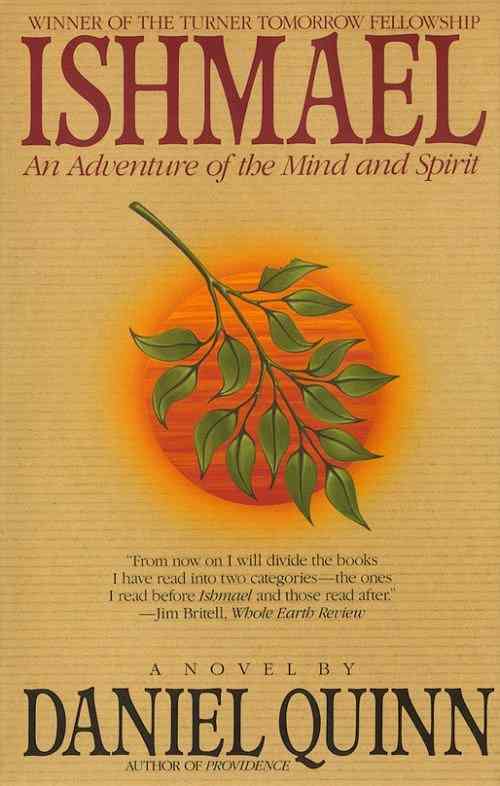
Ishmael, by Daniel Quinn

Ishmael
Daniel Quinn

My blog is visually boring. I know this. The only way I can think of overcoming the blah is by adding some pics. If I overdo it, as I have a tendency to do sometimes, please let me know.

Anyway.

I borrowed Ishmael from a friend in college, and ever since returning it, I have felt I needed to own it. All week, I've been eagerly awaiting it from Amazon, yet a part of me was afraid that I would find the book has lost its meaning. I remember the book as life-changing, and a part of me feared that I would no longer find the book as momentous as I found it in my more idealistic years. Thankfully, my fears were baseless.

Ishmael is a simply told book; its purpose is to educate first and foremost, and style is sacrificed to the import of the book's message. This is actually okay with me, because a heavy style would obscure the message of the book, and that would be too great a loss to bear. The message is simple: namely, that our entire mythology (not Christian mythology or even American mythology--rather, the mythology of every "civilized" nation in the world) is not only entirely wrong, but causing our very destruction.

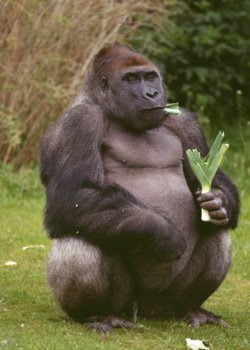
The story begins with our nameless narrator finding an ad in the paper: TEACHER SEEKS PUPIL. Must have an earnest desire to save the world. Apply in person. He goes, and is astonished to find his teacher, the one person who might be able to help him find the answers he has always lacked is none other than a gorilla. But this is no ordinary gorilla, for Ishamel has been educated and can communicate, and his objective stance allows him to observe humanity and understand the beliefs that control us without our even being aware of them.

Our narrator learns the source of his uneasiness and comes to answer many questions through his conversations with Ishmael. For example, why do "civilized" nations experience such high numbers of suicide, crime, drug abuse, and "primitive" cultures do not? Why are civilized people so unhappy, so unfulfilled, despite the technology which is supposed to make life easy? The quick answer is that the problem with our civilization is found in our beliefs. It would be easy for me to summarize these beliefs here, but that would ruin the fun of discovering them through the reading of the book. Go read it.

Illumination Factor: High, for illumination is all there is to Ishmael. Its purpose is to educate, nothing more. True, it is entertaining, but only to a point; after that, it becomes troubling. Still, I believe that this is a book that must be read by every individual.

In a nutshell: Stylistically simple, Ishmael's message is of supreme importance here. It will make you understand human history in way that cannot be found in any classroom or textbook. You will never think the same way again.

Bibliolatry Scale: 5.5 out of 6 stars

Sunday, June 11, 2006

A House for Mr. Biswas, by V.S. Naipaul

A House for Mr. Biswas
V.S. Naipaul

I respect A House for Mr. Biswas, but I can't say I enjoyed it. It's a difficult book, and I felt every single page. However, Naipaul has been part of my attempt to read recent Nobel Laureates, and I'm glad that I just managed to get through this one in a timely manner.

The book centers on Mohun Biswas, a Hindu man living in Trinidad. He is born unlucky, and eventually marries into a luckless marriage to Shama Tulsi. The book chronicles his attempts to find a home of his own as he desperately tries to leave the home of his wife's people.

The writing is superb, as is Naipaul's meticulous observations of the delicate interactions between people. And yet, it all struck me as a bit cold. I pitied the plight of Mr. Biswas, who only wanted to get away from the billion people jammed under the Tulsi roof, but I didn't quite feel for him. I felt bad that the guy could never get a break, but he didn't exactly help matters. Most of the other characters were annoying and unlikable, just as Mr. Biswas found them all to be.

A House for Mr. Biswas has been described as "epic," and it is, but I wish it weren't. Had the book been shortened by even 200 pages, the book might have been more enjoyable. On the positive side, I truly felt Mr. Biswas' frustration at the interminable time it took for him to realize his goal.

Illumination Factor: Well, he won the Nobel, so it's not surprising that the book provides great insight. Apart from obvious truths (i.e., don't marry unless you have thought about it for a very long time and NEVER live with your in-laws), A House for Mr. Biswas is clear about an individual's obligation to society: support yourself and your family without having to depend on others. Hard work doesn't always pay off, and it certainly doesn't guarantee that one will move ahead in the world. But above all, avoid being dependent. Dependence on others is hell.

In a nutshell: Great literature, but it did not create too much of an emotional attachment. Beautifully and painstakingly written, A House for Mr. Biswas is a slow read but has some great moments.

Bibliolatry Scale: 3.5 out of 6 stars

Wednesday, June 07, 2006

In Cold Blood, by Truman Capote

In Cold Blood
Truman Capote

With the recent success of Capote, very few are still unaware of the facts surrounding In Cold Blood, and yet, up until last week, I was. In Cold Blood has entered my list of books to read, come off, and gone on again ad nauseum. Finally, I could no longer ignore the fact that this is one of those books that must be consumed if one wishes to consider herself well-read.

While reading it, I was surprised my compulsion to read more and more, even after I felt I could no longer do so, especially considering the outcome was already generally known. I was also surprised by my level of sympathy for Perry Smith, one of the murderers. Even though he is apparently the perpetrator of all of the murders, reading about his background made his anti-social behavior pitiable. The other murderer, Dick Hickock, the "less violent" of the two, inspired no such pity in me. Of course, the greatest pathos is to be found in the re-enactment of the Clutters' last day on earth. They worked, laughed, and planned for tomorrow, unaware of the fate that would befall them. So too do we all.

The only drawback to the book is its lack of pictures, and this probably has more to do with my edition than with the book itself. After reading Capote's meticulous descriptions of the victims and their murderers, who doesn't want to see what they looked like in life? I often had to interrupt my reading to Google various names. There are some great sites which have all sorts of pictures, including the family, their home, the surrounding area, and, of course, the murderers themselves. It was interesting to see just how accurate Capote's descriptions are. Hickock is as ugly as he is described. But what beauty in Smith's face--just like a movie star's.

The beauty of this vicious man leads me to what will be--and what should have been from the beginning--a feature of my reviews: the Illumination Factor. It is my belief, as I have written in my profile, that good literature enables one to lead a better life. Under my profile, I have added the words of James Salter (whose novel Light Years I found utterly worthless, except that it yielded my favorite literature quote of all time), who has expressed this idea much better than I could hope to. At any rate, I have realized that my reviews should include an explanation of just how a book will enable one to live better, if at all. Sometimes I have done this better than others, but from now on I will devote a specific section to this idea.

The Illumination Factor of In Cold Blood is, not surprisingly, high. Consider Perry Smith: an intelligent, gifted, artistic man. Had a few circumstances--even just one--been different in his life, there is no telling how different he might have been. In Cold Blood stands as a reminder to keep in mind the potential every life has to go awry. Even now, sitting here in my nice home, with my children (three dogs) underfoot, how quickly it could be taken away, how easily it might never have been. Had I not taken school so seriously, had I not lost certain bad influences in my life... How true are the words, "There but for the grace of God go I." The book also reminds one to never become complacent with one's life: you could go in years, or in hours. That, however, I try to always remember; more important for me was to never take my safety for granted. Just because one lives in rural Kansas (or suburban Pennsylvania) does not mean safety is any more assured than in New York City.

In a nutshell: a classic that deserves the label. As many have noted, In Cold Blood's greatness lies not in its story, as there are unfortunately many murderers and their victims, but in its telling. Truly enthralling.

Bibliolatry Scale: 5.5 out of 6 stars

Saturday, June 03, 2006

A Child Called "It", by Dave Pelzer

A Child Called "It"
Dave Pelzer

This is one survivor's tale of horrific child abuse. David Pelzer and his younger brothers enjoyed an idyllic existence, until, one day, for no reason at all, his mother began to abuse Dave. Treating her other sons as princes, she singles out her oldest son as "the bad boy" who is the source of all her problems. She starves him daily, forces him to drink ammonia, burns him on the stove, puts him in a homemade "gas chamber," and even stabs him. I didn't even give it all away.

This torture lasts for years, as his father weakly looks on, too intimidated to step in and save his little "tiger." In time, his younger brothers come to believe that Dave truly is a monster, and participate in his abuse.

Years pass, and Dave becomes an outcast at school: he is rarely allowed to bathe, so he stinks; he is rarely allowed new clothes, so his are worn with holes; he is rarely allowed to eat, so he steals from other students' lunches. FINALLY, years after this torture began, school personnel take notice and report Dave to the authorities, who free him from his mother. He ends up becoming the third worst case of child abuse in the state of California.

This is a short book; it can be read in about an hour or two, depending on your reading speed. It is a simply told tale that reminds us never to allow suspicions of abuse to pass quietly by. However, one problem with the book is its cover: it appears to be a cheesy book on self-help or new-age spirituality, instead of the moving tale of survival that it is. Check it out:


If I didn't already read about the book, I wouldn't be tempted to pick it up on its own. True, you should never judge a book by its cover, but lame covers don't help. In a time when the James Freys of the world have cast a doubt on memoirs, having a cloud-hand touching a child's chin does not add to one's credibility. That is not to say I disbelieve a single word of his book; in fact, there are letters from teachers and administrators who finally saved Dave which add legitimacy to his tale. Because of the serious nature of A Child Called "It", the book deserves a serious treatment. So ix-nay on the oud-hand-clay.

My other gripe with the book is that we never learn WHY the mother changed from being perfect and loving to awful and full of hate. Is she schizophrenic? On drugs? Abused herself? We don't know. OF course, there could never be a justification for her behavior, but I'd like to hear something. Maybe that comes in part 2, explaining Dave's teen years in foster care. Or part 3, discussing Dave's adult years.

In a nutshell: Not for the faint of heart, but at least you know he survives to tell the tale.

Bibliolatry Scale: 4 out of 6 stars